
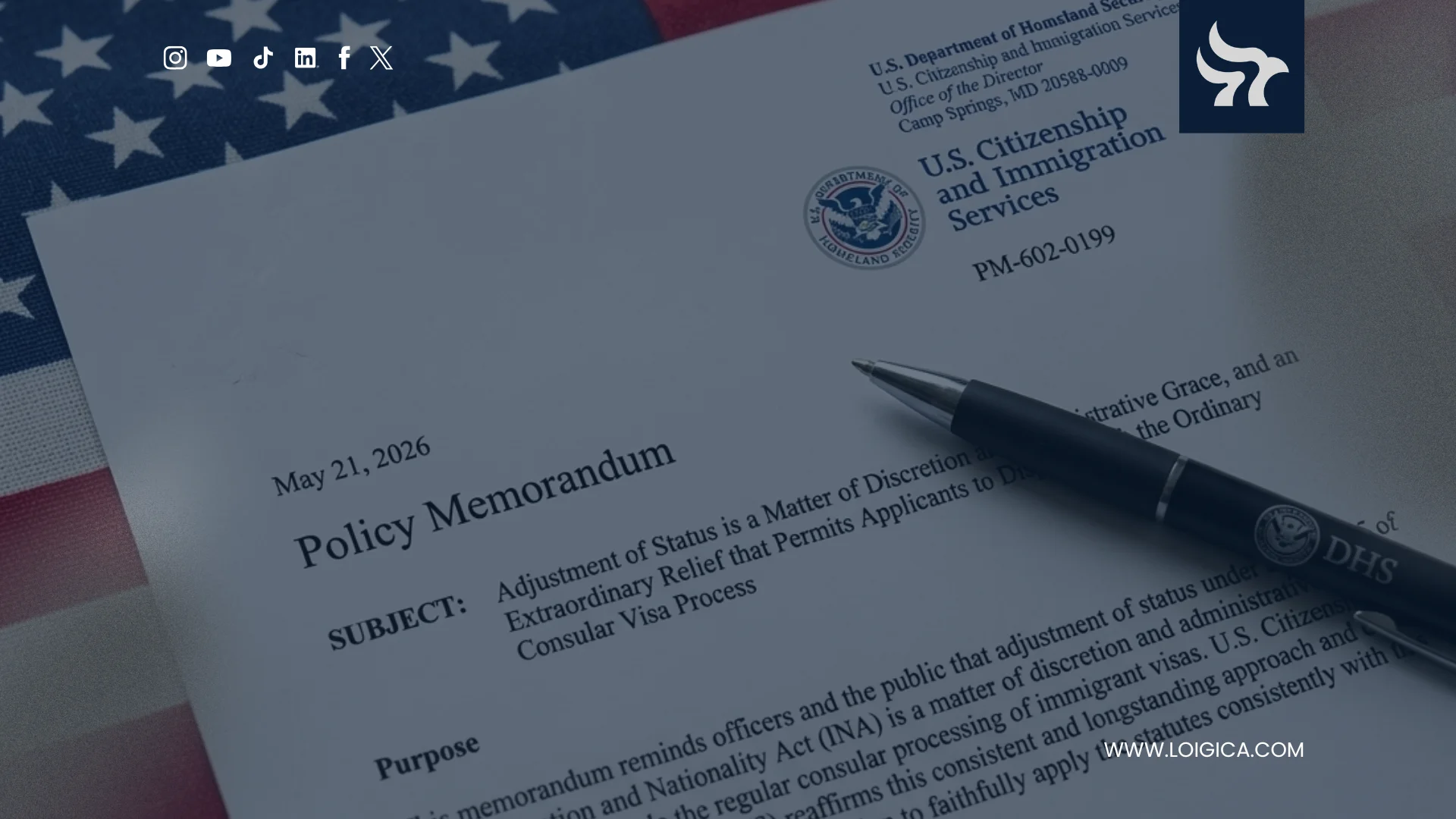
USCIS announced a new policy on adjustment of status in May 2026. The guidance signals a stricter approach for people seeking a Green Card from inside the United States.
The policy does not eliminate adjustment of status. It also does not mean that every pending case will be denied.
Instead, USCIS is reminding officers that adjustment under INA §245 is discretionary. Being eligible to apply may not be enough. Officers must also decide whether the applicant deserves a favorable exercise of discretion.
For people already in the United States, this makes careful case preparation even more important.
What USCIS announced
USCIS issued the policy memorandum on May 21, 2026. The agency followed it with a public announcement on May 22.
The memo describes adjustment of status as a matter of discretion and “administrative grace.” It also emphasizes the traditional immigrant visa process through a U.S. consulate abroad.
This does not create an automatic denial rule.
Officers still have to review each case based on its facts. They must consider both positive and negative factors.
The important change is the emphasis on discretion.
An applicant may meet the basic legal requirements for a Green Card. USCIS may still ask whether adjustment inside the United States is appropriate in that specific case.

Loigica’s legal perspective: love, talent, and money
Harry Tapias, CEO and immigration attorney at Loigica, explained that many U.S. immigration stories begin through one of three pathways: love, talent, or money.
Family and marriage-based cases, employment-based cases, extraordinary ability profiles, physicians, researchers, professionals, investors, and business owners may all need a closer review when the applicant is already in the United States and plans to pursue adjustment of status.
Harry also emphasized an important point: the memo does not eliminate adjustment of status. Legitimate cases can still qualify. What changes is the need for stronger preparation, credible documentation, and a clear explanation of why the case supports a favorable discretionary decision.
For lawful permanent residents with already approved Green Cards, the memo should not be read as a reason to panic. The concern is mainly about how USCIS may review pending or future adjustment of status applications, especially where prior overstays, unauthorized employment, immigration violations, or conduct inconsistent with the original visa purpose may be present.
This aligns with the memo’s instruction that officers should weigh the totality of the circumstances, including both positive and negative factors, before deciding whether to grant adjustment of status as a matter of discretion.
USCIS also framed the change in stronger public language
In its public communication, USCIS stated that a person who is in the United States temporarily and wants permanent residence should generally return to their home country to apply, except in extraordinary circumstances.
That public framing is important, but the memo does not remove officer discretion or create an automatic denial rule for every adjustment case. It directs officers to weigh the totality of the circumstances, including immigration history, status violations, failure to depart, available consular processing, dual intent, and positive and negative discretionary factors.
Does this affect all adjustment of status applicants?
The memo is broader than parole cases alone.
USCIS discusses two major groups that often seek adjustment under INA § 245: people who were inspected and admitted, and people who were inspected and paroled. It also says that, with limited exceptions, Congress generally expected nonimmigrants and parolees to depart the United States after the purpose of their admission or parole ended.
That language could affect many applicants who are in the United States temporarily, including some people in nonimmigrant status.
There is one important clarification. USCIS acknowledges exceptions, including dual intent nonimmigrant categories and immigrant categories where adjustment of status may be the available path to permanent residence.
The memo also says that applying for adjustment is not inconsistent with maintaining lawful dual intent status. Still, maintaining dual intent status alone does not automatically guarantee a favorable discretionary decision.
What officers may review more closely
The memo tells officers to consider all relevant facts in the record.
That review may include:
- immigration history;
- maintenance of lawful status;
- violations of status;
- unauthorized employment;
- fraud or false testimony;
- conduct inconsistent with the purpose of admission, parole, or visa issuance;
- failure to depart when expected;
- family ties, moral character, and other positive or negative factors.
USCIS also states that if it denies a case based on discretion, the denial notice must explain the positive and negative factors considered and why the negative factors outweighed the positive ones.

What this may mean for people already in the U.S.
This memo may be especially important for applicants who entered the United States in a temporary status and later seek a Green Card without leaving.
Students, tourists, temporary workers, parolees, and other nonimmigrants may need a closer review before filing or continuing an adjustment of status strategy.
The same is true for people with prior overstays, unauthorized work, status violations, inconsistent visa history, or cases where consular processing may be available.
For some applicants, adjustment of status may still be a valid path. For others, consular processing may become a more important part of the strategy. The answer depends on the visa category, immigration history, current status, admissibility, timing, and available exceptions.
What applicants should review now
Anyone considering adjustment of status should review the full case before filing. Key questions include:
- What status does the applicant currently hold?
- Has the applicant maintained that status?
- Was there any unauthorized employment?
- Is consular processing available?
- Does the applicant hold a dual intent status?
- Are there strong positive factors in the record?
- Could leaving the United States trigger other immigration risks?
Loigica can help applicants, families, employers, and investors review whether adjustment of status, consular processing, or another strategy fits the facts of the case. Contact us now.

Why this matters
The memo does not erase adjustment of status. It does, however, make discretion harder to ignore.
As Harry Tapias explains, immigration strategy still depends on a legitimate pathway: family, work, talent, investment, or business. After this memo, preparation and credibility matter even more for applicants seeking a Green Card from inside the United States.
Applicants should not assume that technical eligibility will be enough. USCIS is telling officers to look closely at whether an adjustment should be granted as an exception to the ordinary consular process.
For clients already in the United States, that means the strategy should be reviewed before filing, before changing status, and before assuming that adjustment of status is the safest path.
Disclaimer
This article provides general information about USCIS’ May 2026 policy memo on adjustment of status. It does not provide legal advice and does not create an attorney-client relationship. Immigration rules, agency guidance, adjudication practices, and consular processing policies may change. Each case should be reviewed based on its specific facts before any legal decision is made.

Adjustment of Status Review
Considering adjustment of status after this USCIS memo? Loigica can review your current status, immigration history, consular processing risks, and available Green Card strategy before you move forward.