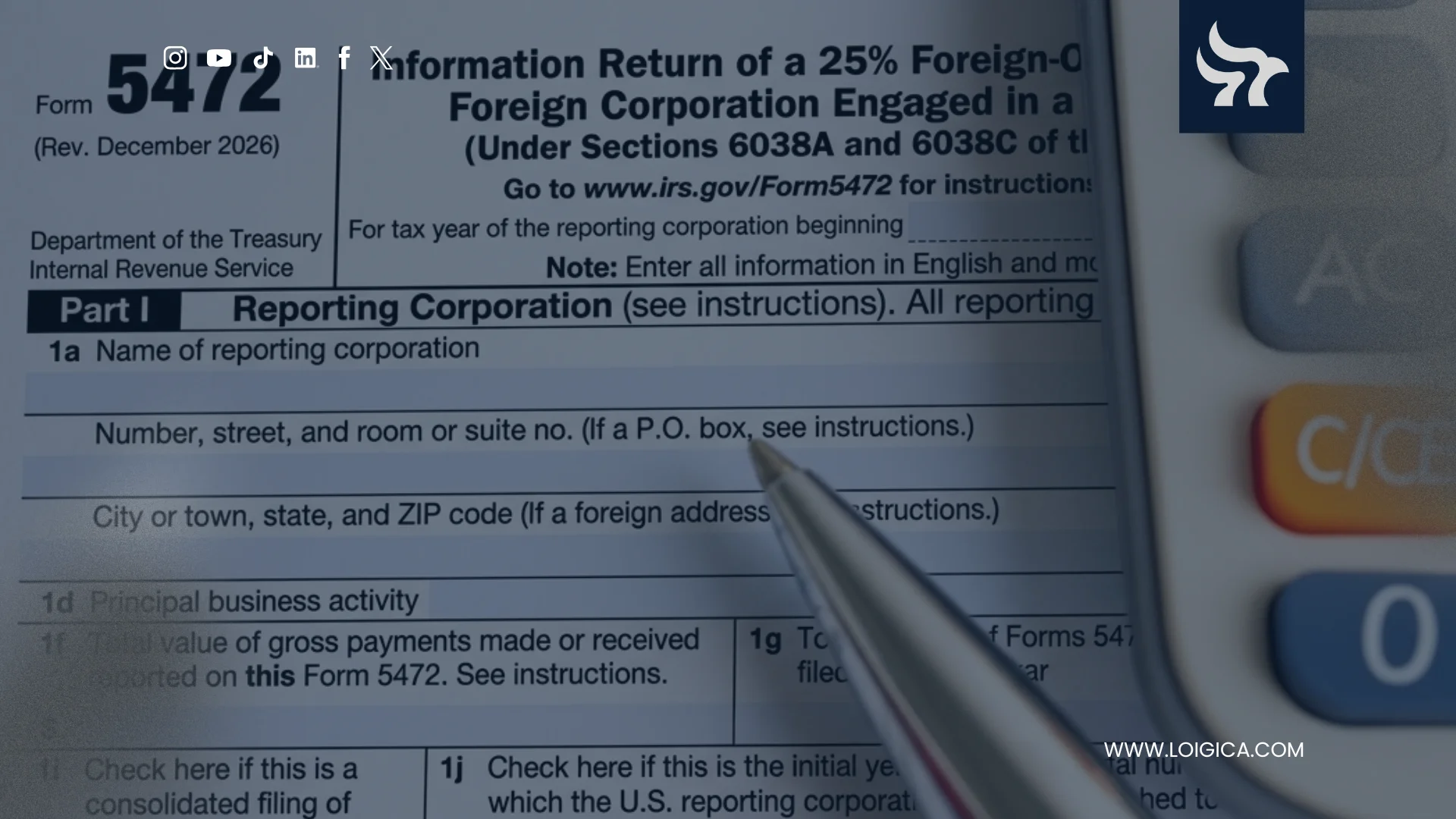
Form 5472 creates confusion for many foreign-owned entities. Most problems start with a basic mistake: owners focus only on the date and ignore the structure behind the filing. The real issue is not only when Form 5472 is due in 2026, but who must file it, what return it follows, and how the IRS views the entity. The IRS explains that Form 5472 reports certain transactions with related parties under sections 6038A and 6038C. In this article, we are going to dive into all the details you must know to stay compliant.
What Is Form 5472?
Form 5472 reports certain transactions between a reporting corporation and a related party. The form does not work like a simple standalone notice. In most cases, the entity files it with the applicable tax return, not by itself as an isolated document. That distinction matters because the due date usually follows the return it attaches to.
Who Must File Form 5472?
The IRS applies Form 5472 to several categories of filers. A 25% foreign-owned U.S. corporation may need it. A foreign-owned U.S. disregarded entity may need it too. In some cases, a foreign corporation engaged in a U.S. trade or business must also file it when reportable transactions exist. That is why the legal classification of the entity matters more than the casual label the owner uses.
Many nonresident founders run into trouble with the foreign-owned single-member LLC. They hear that the LLC is “disregarded” and assume the IRS ignores it for all purposes. The IRS does not take that view for Form 5472 reporting. For information reporting, a foreign-owned disregarded entity can still have a real filing obligation.

Form 5472 Deadline in 2026
The Form 5472 deadline in 2026 depends on the return the entity must file. There is no single universal due date for every filer. The IRS instructions say the entity must file Form 5472 by the due date of its income tax return, including extensions. That rule shapes the whole analysis.
For many calendar-year corporations that file Form 1120, the return for tax year 2025 is due on April 15, 2026. So, when Form 5472 attaches to that return, many filers will also face an April 15, 2026 baseline deadline. That date matters, but it only matters after you confirm the entity type and the return framework.
Form 5472 Deadline for Foreign-Owned Disregarded Entities
This is where many nonresidents make expensive mistakes. The IRS requires a foreign-owned U.S. disregarded entity to file a pro forma Form 1120 with Form 5472 attached when the reporting rules apply. That means many single-member LLCs owned by nonresidents still have a filing duty even when they do not file a normal income tax return in the usual sense.
The IRS also gives these entities special filing rules. They do not use the regular Form 1120 filing address for this purpose, and the IRS says they cannot e-file Form 5472 in this context. So the compliance issue is not only substantive. It is also procedural.
For a calendar-year foreign-owned disregarded entity with a 2025 tax year, the practical starting point is usually April 15, 2026, unless the entity secures a timely extension. In practice, owners often miss the filing because they never realized the LLC had a reporting requirement at all.
What Counts as a Reportable Transaction?
The IRS defines reportable transactions broadly. The list can include sales, leases, services, loans, interest, royalties, contributions, distributions, and other dealings with related parties. So a company does not need a massive transaction history to trigger Form 5472. Even modest activity between the U.S. entity and a foreign owner can create a filing issue.

How Extensions Work
A timely extension can move the filing deadline, but it does not solve a bad setup. The IRS uses Form 7004 to grant an automatic 6-month extension for certain business returns, including Form 1120 series returns. The key point is timing: the entity must file the extension by the due date of the return.
That is why many owners wait too long. They ask about Form 5472 in April, but by then they may still lack books, transaction support, or clarity about the entity’s tax classification. The filing problem often reveals an older structural problem.
Why the Penalty Risk Is Serious
The IRS treats Form 5472 penalties seriously. The agency states that it may impose a $25,000 penalty for each failure to file a complete and correct Form 5472 by the due date. If the IRS sends a notice and the failure continues for more than 90 days, it may impose additional $25,000 continuation penalties for each 30-day period. The IRS also says no maximum penalty amount applies to those continuation penalties.
That does not mean every late filing ends the same way. However, it does mean owners should not treat Form 5472 like a small administrative form. A small entity can create a very large compliance problem when it ignores the filing for multiple years.
Common Mistakes Nonresidents Make With Form 5472
Nonresidents often assume no U.S. income means no U.S. filing. They also assume a small foreign-owned LLC is too minor to attract reporting rules. Others think they can send it later by itself once they discover the issue. The IRS instructions do not support that casual approach. The filing ties back to the entity’s return, its related-party transactions, and its records.
Another mistake comes from focusing only on the deadline. A smarter review starts with the entity type, tax classification, foreign ownership, and transaction history. Once those points are clear, the due date becomes easier to identify and defend.

What Nonresident Owners Should Review Before the 2026 Deadline
Before the 2026 deadline, owners should confirm how the U.S. entity is classified for federal tax purposes. They should also identify any reportable transactions with a foreign owner or related party.
Next, they should confirm which return Form 5472 must follow and decide whether they need Form 7004. Finally, they should gather records that support every relevant amount. Those steps sound simple, but they often uncover the real compliance risk.
Why work with Loigica?
Form 5472 in 2026 is not only a calendar issue. It is a structure issue, a reporting issue, and often a documentation issue. The goal is not only to file on time. The goal is to file the correct form, with the correct return, under the correct entity structure. For nonresidents, that difference can prevent avoidable penalties and bigger problems later.
At Loigica, we help nonresidents review whether their U.S. entity structure, tax classification, and reporting obligations align correctly. We identify Form 5472 exposure, clarify filing requirements, and help clients address preventable risks before they turn into expensive compliance problems.
Schedule a consultation and review your current situation to avoid unnecessary risks.