
The R1 visa, officially the R-1 nonimmigrant religious worker classification, lets certain religious workers come to the United States for temporary religious work. The role must average at least 20 hours per week.
Not every religious activity needs this visa. The State Department says some short religious trips may fit a visitor visa instead. That can include conferences, temporary pulpit exchanges, or religious tours paid from abroad. When a U.S. religious organization will employ the worker in the United States, the R category is usually the right path.
What Is the R1 Visa?
The R1 visa is for a person who will come to the United States to work as a minister, or in a religious vocation or religious occupation, for a qualifying religious organization. USCIS also requires the worker to have been a member of the same religious denomination for at least two years immediately before the petition is filed.
That last point matters. The case is not only about the worker’s role. It is also about the organization, the denomination, the work itself, and the evidence tying those pieces together. USCIS policy guidance separately addresses both petitioner requirements and beneficiary requirements, which is why weak documentation on either side can create problems.
R1 Visa Requirements
Most R1 visa requirements come down to a few core points:
- The worker has belonged to the same religious denomination for at least two years before filing.
- The U.S. organization qualifies as a nonprofit religious organization, or as an eligible affiliated organization.
- The role is a minister position, a religious vocation, or a religious occupation.
- The job averages at least 20 hours per week.
- The petition includes evidence of compensation and the terms of the role.
This is where many cases get weak. A sincere mission is not enough by itself. USCIS wants to see a qualifying petitioner, a qualifying role, and solid support for both.
If your organization is not sure whether the role qualifies for R1 status, contact Loigica to review the case.
How the R1 Visa Process Works
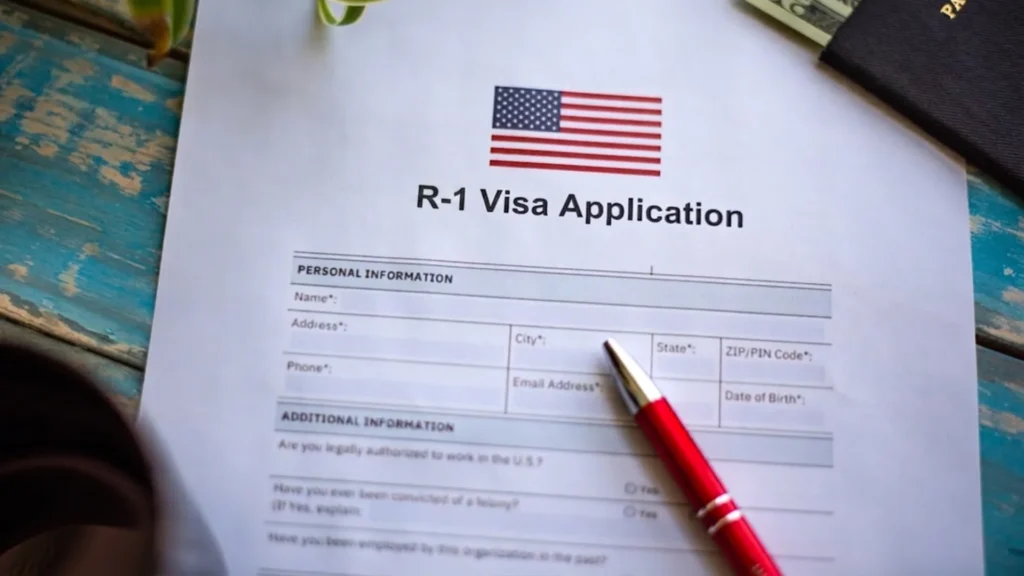
The process usually starts with the U.S. religious organization. That organization files Form I-129 with USCIS. If the worker is abroad, the person then uses the approved petition to apply for the visa at a consulate. The State Department says the worker needs an approved I-129 petition before applying for the visa abroad.
USCIS may also inspect the worksite. The agency uses site visits to verify the facts in the petition. That can include the organization, the duties, the worksite, the hours, and the compensation.
Premium processing may also be available. USCIS says premium processing covers certain Form I-129 cases, including R-1 petitions.
How Long the Visa Lasts
USCIS says R-1 status may be granted for an initial period of up to 30 months. One extension may then be granted for up to an additional 30 months, with a total maximum stay of 5 years.
There is also an important current update here. In January 2026, DHS issued an interim final rule removing the prior one-year foreign residence requirement that many R-1 workers had to meet after reaching the five-year maximum. USCIS now states that although the worker must still depart at the end of the five-year maximum admission period, there is no longer a one-year wait abroad before becoming eligible again for R-1 status.
That does not mean the R1 visa became permanent. It did not. It means the old waiting-period rule changed, which can affect long-term planning for religious organizations that rotate workers or build multi-stage immigration strategies.
Religious Worker Visa Dependents
The spouse and unmarried children under 21 of an R-1 worker may apply for R-2 classification. USCIS states that R-2 dependents are not authorized to work based on that status, though they may study. USCIS also notes that extensions or changes of status for R-2 dependents are requested through Form I-539.
This matters for family planning. In some cases, the principal worker may qualify for R-1, but the overall strategy still needs a closer review because the dependent spouse cannot work in R-2 status.
R1 Visa to Green Card: When the Path Makes Sense
A common question is whether the R1 visa to green card path is real. In many cases, yes. USCIS allows ministers and non-ministers in qualifying religious vocations and occupations to seek permanent residence through the EB-4 special immigrant religious worker category.
But this is not automatic. The permanent category has its own rules, filing strategy, and timing issues. USCIS says ministers are not subject to a numerical limit, while all other religious workers are subject to an annual limit of 5,000. USCIS also notes that the non-minister special immigrant religious worker program is currently extended only through Sept. 30, 2026.
Visa availability can also become a real issue. The State Department’s Visa Bulletin continues to control when numerically limited EB-4 cases can move forward, which means the R1-to-green-card path can depend not only on eligibility, but also on priority dates and category availability.
If you are planning around both R1 status and a future green card strategy, Loigica can help you assess timing, eligibility, and supporting evidence.

What Employers and Religious Organizations Often Miss
One common mistake is treating the case as if the title alone controls. It does not. USCIS looks beyond labels and verifies the religious nature of the work, the relationship between the worker and the denomination, the organization’s qualifying status, and the evidence of compensation and work conditions. USCIS may verify those facts through site inspections.
Another mistake is forgetting the limits of R1 status. USCIS states that an R-1 worker may work only according to the terms of the approved petition and may not work in the United States in another capacity while holding R1 status.
A third mistake is assuming that “R1 visa to green card” is one simple next step. Sometimes the transition works well. Sometimes the permanent path needs separate analysis, especially for non-minister cases affected by annual limits, program extensions, or visa bulletin movement.
Keep Learning About the R1 Visa
At Loigica, we understand that religious worker cases often involve more than one question at once. The visa itself, the organization’s eligibility, the structure of the petition, family planning, and long-term green card strategy may all need to work together. Learning the basics is useful, but a strong case usually depends on how those pieces fit in practice.
Need Help Reviewing an R1 Visa Case?
Share the role, the religious organization, and the long-term goal with Loigica, and we can help you assess whether the case is ready for filing and how it may connect to a future permanent residence strategy.