

Preparing for the F1 visa interview questions is not only about memorizing answers. Before the interview, you should understand your own study plan: what you want to study, why you chose that school, how you will pay for the program, and what connects you to your home country.
At Loigica, we explain this to students who are just starting the process: the F1 visa is a student visa. It is meant for people whose main purpose is to study in the United States, not to work or move permanently without a clear academic plan.
What the F1 visa interview is really testing
Aside from checking whether a school accepted you. The officer is reviewing whether your story makes sense. With our student clients, we advise preparing these key questions that they should be ready to explain:
- why you want to study in the United States?
- Why did you choose that program?
- how long the program will last;
- how you will pay for school and living expenses;
- What ties do you have to your home country?
- What is your plan after completing the program?
Students generally need an F or M visa to travel to the United States for study, and that students must first be accepted by a school or program before applying for the visa.
The F1 visa is for studying
The F1 visa is a non-immigrant visa. That matters.
We always explain that the F1 visa has a specific purpose: completing an educational program in the United States. It can apply to English programs, universities, graduate degrees, master’s programs, and other approved academic studies.
The F1 visa does not automatically lead to a Green Card. It also should not be presented as a work strategy if your real goal is employment in the United States.
Before the interview, your study plan should feel clear and honest. You should know what you are studying, why it matters, and how it fits into your personal or professional path.
We have law experts who will help you prepare a strong case. Contact us to schedule a meeting here.
School acceptance and the Form I20
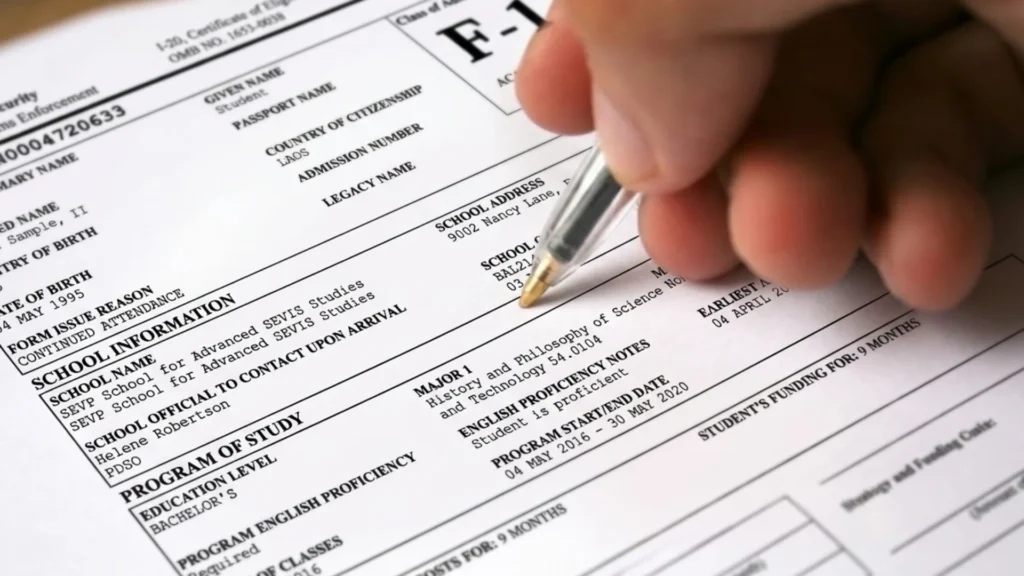
One of the most important documents in an F1 case is the Form I20.
We would like to point out that the I20 shows that the student was accepted by the educational institution. It also includes details about the program, duration, costs, and student obligations.
The student process starts with applying to a SEVP-certified school. Once accepted, the student receives the Form I20, pays the I901 SEVIS fee, and then moves forward with the student visa process.
For the interview, you should understand what your I20 says. Do not treat it as paperwork you simply carry to the consulate. To our clients, we explain that they should be able to answer without any hesitation:
- the school name;
- the program;
- the start date;
- the expected length;
- the estimated cost;
- How will they cover those costs?
If you can answer all these items correctly, it will put you on the approval path.
F1 visa interview questions students should prepare
Every interview is different, but many F1 visa interview questions come back to the same core issues. We created a simple table that will help you understand these core questions and the issues that they want to address.
| Question | What the officer may be reviewing |
|---|---|
| Why do you want to study in the United States? | Whether your purpose is genuinely academic |
| Why did you choose this school? | Whether your school choice makes sense |
| What program will you complete? | Whether you understand your academic plan |
| How will you pay for your studies? | Whether your financial plan is credible |
| What ties do you have to your home country? | Whether you can show nonimmigrant intent |
| What will you do after the program? | Whether your plan is consistent with the F1 visa |
Our goal is not for you to sound rehearsed. Our goal is for you to be clear.
If you cannot explain your own program, your funding, or your plan after graduation, the interview can become harder.
Financial documents and proof of funds
There is no single amount that works for every F1 visa case.
The amount depends on the school, the program, the duration, tuition, living costs, and the estimate reflected in the I20. We explain that the I20 helps show the budget the student must be ready to cover.
Your financial story should match your study plan. A short English program and a multi-year degree will not require the same financial preparation.
Depending on the case, financial evidence may include bank statements, family support, scholarships, income records, sponsor letters, or other documents. The important point is that the officer can understand how you plan to pay for the program without using the F1 visa as a work visa.
If you need guidance to prepare a strong case at Loigica, we have a team of lawyers who will help you to obtain your F1 visa. Contact us here today.

Home country ties and nonimmigrant intent
For an F1 visa, you should be ready to explain your ties to your home country.
Some common examples could be family, property, career plans, business, assets, or other parts of the student’s life outside the United States.
Not every student has the same ties. If you are a young student, you may not own property or have a long career history. That does not automatically mean the case is weak.
Ask yourself a question: Are your age, studies, family, finances, plans, and reasons for choosing that program coherent?
Before the interview, we recommend reviewing how you would explain:
- your family situation;
- your academic background;
- your professional goals;
- your plans after the program;
- why this study makes sense in your life.
Can F1 students work?
This question comes up often.
The F1 visa is not designed as a general work visa. F1 students may not work off campus during the first academic year, although they may accept on-campus employment under certain conditions and restrictions. USCIS lists options such as CPT and OPT when the student qualifies under specific rules.
If your answers make it sound like your main goal is to work in the United States, the officer may question whether the F1 visa fits your real intention.
We want to note that spouses and children may accompany the principal student under the appropriate dependent category, but the spouse does not receive general work authorization just by accompanying the F1 student.
Common mistakes before the F1 visa interview
Pay close attention. In our work with student visa applicants, we often see problems that could have been reviewed earlier. Be diligent and address these issues before applying for the F1 visa:
- choosing a program without a clear reason;
- not understanding the Form I20;
- bringing weak financial documents;
- giving unclear answers about home country ties;
- treating the F1 visa like a work visa;
- failing to explain why the school or program fits the student’s goals;
- answering interview questions in a way that contradicts the application.
A good interview starts before the appointment. It starts when you choose the school, review the I20, organize financial documents, and prepare a clear explanation of your study plan.

Before applying for an F1 student visa
Before applying, review the basics carefully.
Your F1 case should explain your school, your program, your I20, your financial plan, your home country ties, and your purpose for studying in the United States.
Loigica can help you review your F1 visa strategy, documentation, and interview preparation before you move forward.
Contact us today and start your journey to study in the United States.

Florencia Rodriguez
Social Marketing Manager
Disclaimer
This article provides general information about F1 visa interview questions and student visa preparation. It does not provide legal advice and does not create an attorney-client relationship. Visa requirements, consular practices, employment rules, SEVIS procedures, and immigration policies may change. Each case should be reviewed based on its specific facts before any legal decision is made.
Keep learning about student visas
To keep learning about U.S. immigration options, review Loigica’s resources on student visas, work visas, investor visas, family immigration, and immigration strategy.
F1 Visa Interview Preparation
Preparing for an F1 visa interview? Loigica can help review your I20, school acceptance, financial documents, home country ties, and interview strategy before you apply.