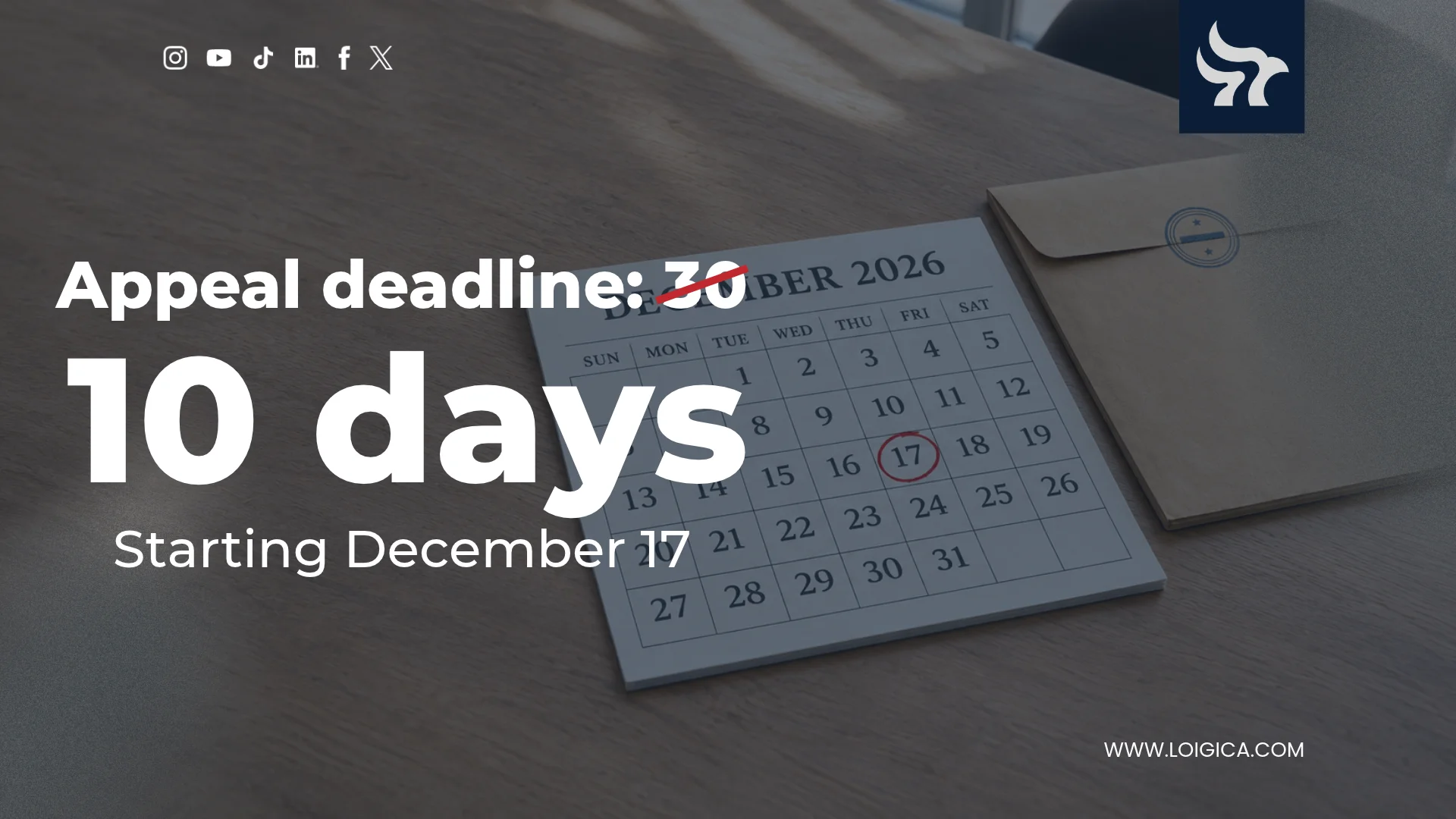
Starting December 17, 2026, most people who file a BIA appeal will have 10 days to do it, down from 30. The change comes from a Department of Justice final rule published on November 17.
The rule does more than shorten the deadline. It also changes how the Board of Immigration Appeals decides which cases get a full review.
Your BIA appeal deadline at a glance
This table summarizes which deadline applies to each type of decision.
| Your situation | Deadline to appeal |
|---|---|
| Decision issued before December 17, 2026 | 30 days, under the old rules |
| Asylum denied on the merits | 30 days, set by statute |
| Asylum denied under the one-year bar, a safe third country agreement, or a prior denial | 10 days |
| Withholding-only or CAT-only cases | 10 days |
| Cancellation of removal, adjustment of status, a waiver, bond, or other relief | 10 days |
| Asylum denied on the merits together with other relief | Safer to file within 10 days |
Every case depends on the judge’s specific decision, so the table is a starting point, not a final answer.
What changes on December 17
The final rule makes three main changes:
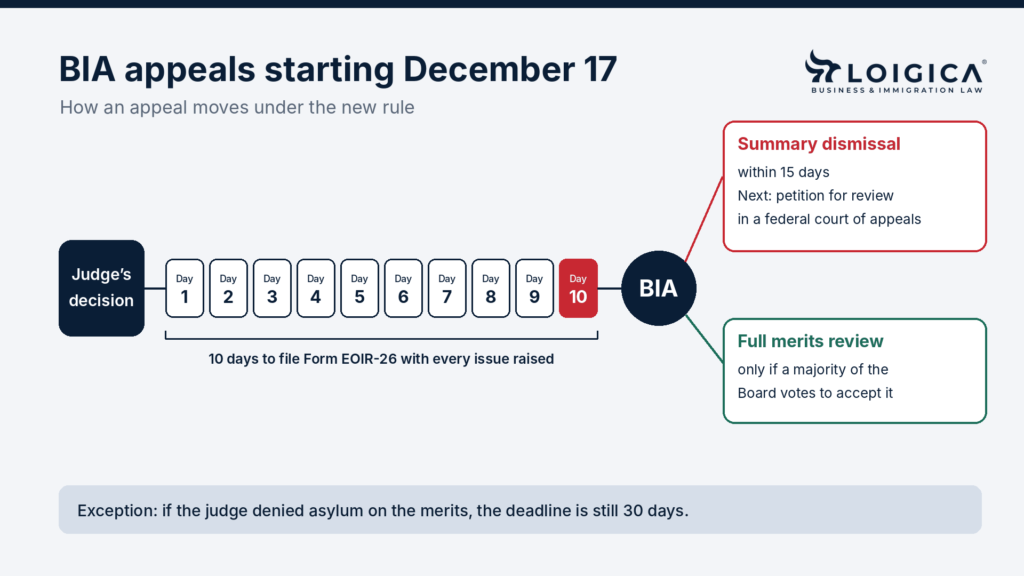
- A 10-day deadline. The Notice of Appeal (Form EOIR-26) must reach the Board within 10 days of the immigration judge’s decision, instead of 30.
- Summary dismissal. The Board can summarily dismiss most appeals within 15 days, unless a majority of its permanent members vote to review the case on the merits.
- Every issue up front. Any issue not raised in the Notice of Appeal is treated as waived. You can no longer file first and build your arguments later.
The third change matters as much as the deadline. In 10 days, every error in the decision has to be identified and written down.
Who the new BIA appeal rules apply to
The rule applies only to immigration judge or DHS decisions issued on or after December 17, 2026. Appeals already pending, and decisions issued before that date, follow the old rules.
There is one key exception. If the judge denied your asylum claim on the merits, you still have 30 days to appeal, because that deadline is set by statute.
The 10-day deadline applies, among other cases, when:
- Asylum was denied under the one-year filing bar.
- Asylum was denied under a safe third country agreement or because of a prior denial.
- The case is withholding-only or Convention Against Torture-only.
- The appeal concerns other relief, such as cancellation of removal, adjustment of status, a waiver, or bond.
If one decision denies asylum on the merits and also denies other relief, the safer choice is to file within 10 days. Talk to our team if you are not sure which deadline applies to you.
The cost of an appeal
The filing fee for Form EOIR-26 is $1,060, not counting attorney fees. That amount has applied since October 1, 2026, so it is not part of this rule. What changes is how fast you need to pay it.
The fee, or a fee waiver request, must be filed with the appeal. Otherwise, the appeal is not properly filed. Fee waivers exist but are not guaranteed.

Why this rule could change again
This is not the government’s first attempt. In February 2026, an interim rule tried the same changes. In March, a federal court vacated the 10-day deadline, summary dismissal, and the waiver provision because there had been no public comment period.
The new final rule brings back all three after a comment period. The same court may now review it on the merits. Until that happens, the safe approach is to treat December 17 as the date that counts.
What to do if you receive an unfavorable decision
- Do not wait. Count the 10 days from the date of the decision, not from the day you read it.
- Plan for the fee before your hearing. If an adverse decision is possible, have the fee or a waiver request ready.
- Review the full decision with an attorney. Every issue must be in the Notice of Appeal.
- Ask what happens if the Board dismisses. The next step is a petition for review in a federal court of appeals, which has its own deadlines.
If you have an individual hearing coming up
With 10 days to appeal, preparation starts before the hearing, not after. It helps to know in advance what relief you are asking for, which issues could be appealed, and how the fee will be paid.
Schedule a consultation and we will look at your case before the date.
How LOIGICA can help
At LOIGICA, we handle cases before the immigration court and the Board of Immigration Appeals. We review the judge’s decision, identify the issues for appeal, and keep track of every deadline.
You can see all the cases we handle on our immigration litigation page.

Harry Tapias
CEO, Co-Founder and Attorney at Loigica
Disclaimer
The information in this article is general and does not constitute legal advice or create an attorney-client relationship. Appeal deadlines and procedures may change due to new court decisions or regulations.
Removal Defense
A BIA appeal is only one part of defending a removal case.
Learn more about removal defense and how we handle these cases.
Received a Decision From an Immigration Judge?
Tell us about your case and our team will contact you to review your deadlines.